Selected Work
Brand Strategy Framework – Agency Standard
A comprehensive brand strategy framework refined and standardized through client engagements — now the agency standard for all brand work.
Overview
As MaaS by CodeSM grew and scaled its client portfolio, brand strategy work was happening without a shared structure. Outputs varied by engagement, and the connection between strategic thinking and creative execution wasn’t always clear.
This project was about solving that problem at a process level. Working from the agency’s existing brand strategy approach, Ruth refined and systematized it through real client application — building it into a repeatable process that produces consistent results at scale. The result covers the full arc from competitive positioning through messaging architecture and campaign ideation, and is now the standard used across all brand strategy work at the agency.
The Problem
Onboarding new clients was slower than it needed to be. The quality of strategic work depended too heavily on who was leading it. And without a shared structure, there was no reliable way to ensure the thinking behind a brand connected clearly to the work that executed it.
The opportunity: transform an inconsistent, lead-dependent process into a reusable framework rigorous enough to produce consistent, high-quality brand systems — and accessible enough to work across industries and client sizes.
What’s Inside
The framework spans six strategic sections, moving from research and discovery through to actionable execution:
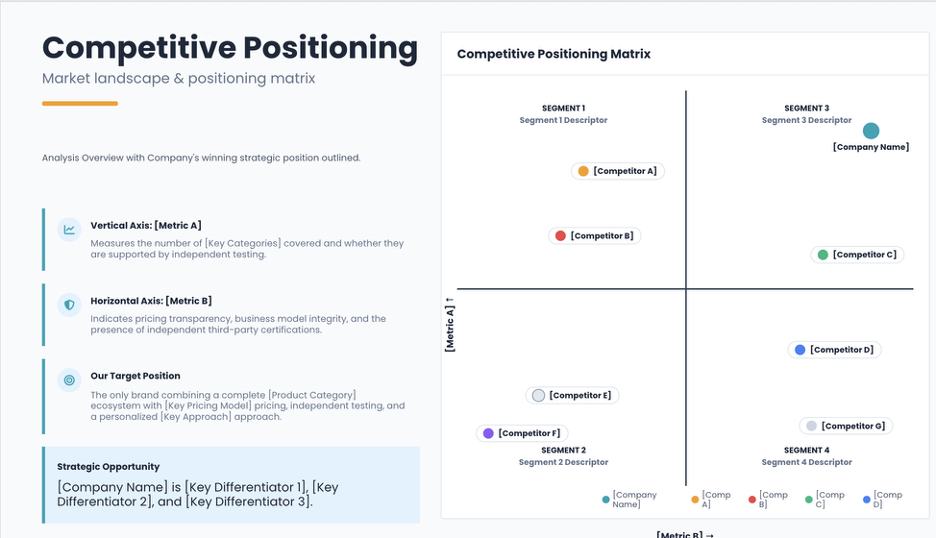
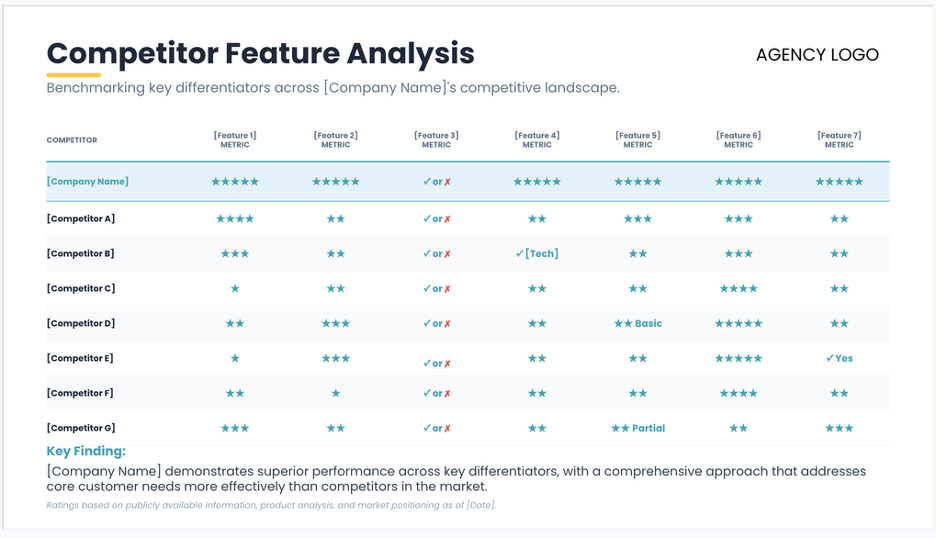
01 — Competitor Analysis Positioning matrix and feature benchmarking across competitors — oriented toward identifying the white space the brand can credibly own, not just cataloging who else is in the market.
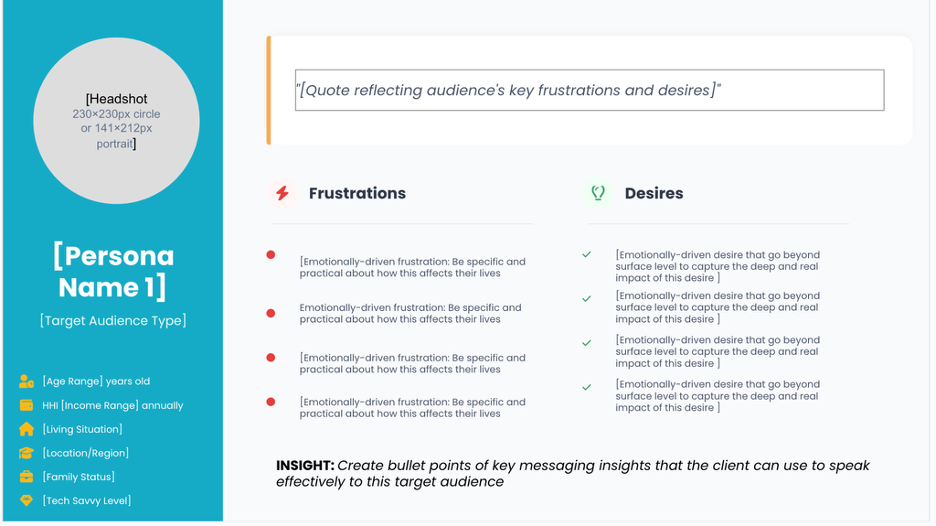
02 — Target Audience Three layered persona profiles, each built around frustrations, desires, and personality spectrums. Understanding the emotional context of the audience shapes every positioning decision that follows.
03 — Brand Identity Brand vocabulary, core attributes, and values — defined with enough specificity to be useful. Voice and tone guidelines that can scale across execution without losing character.
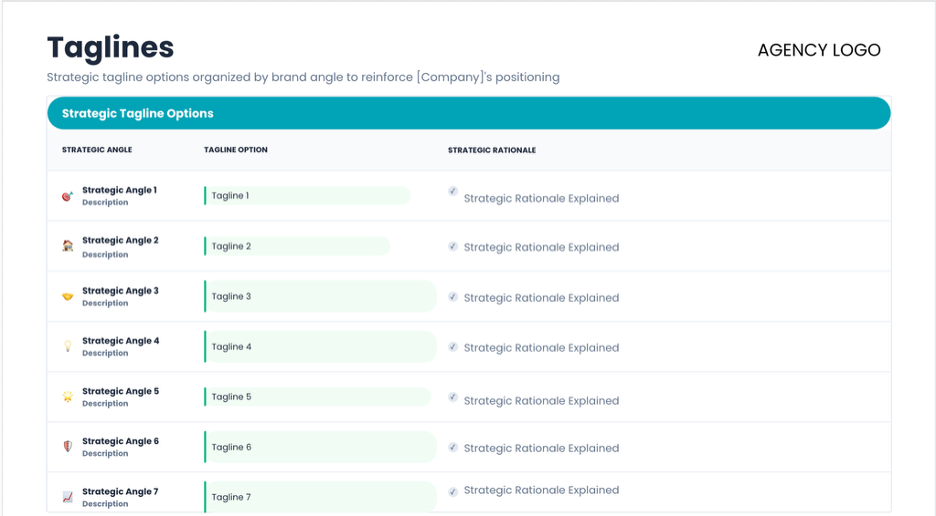
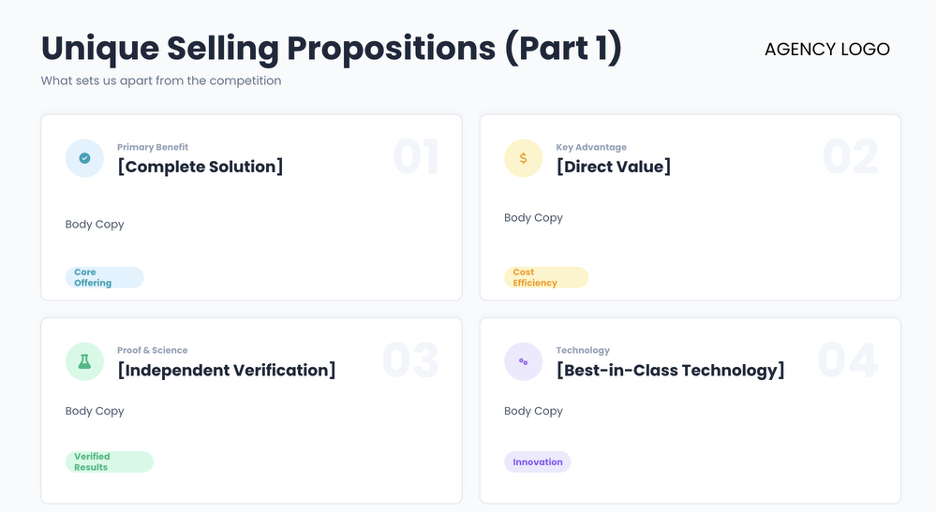
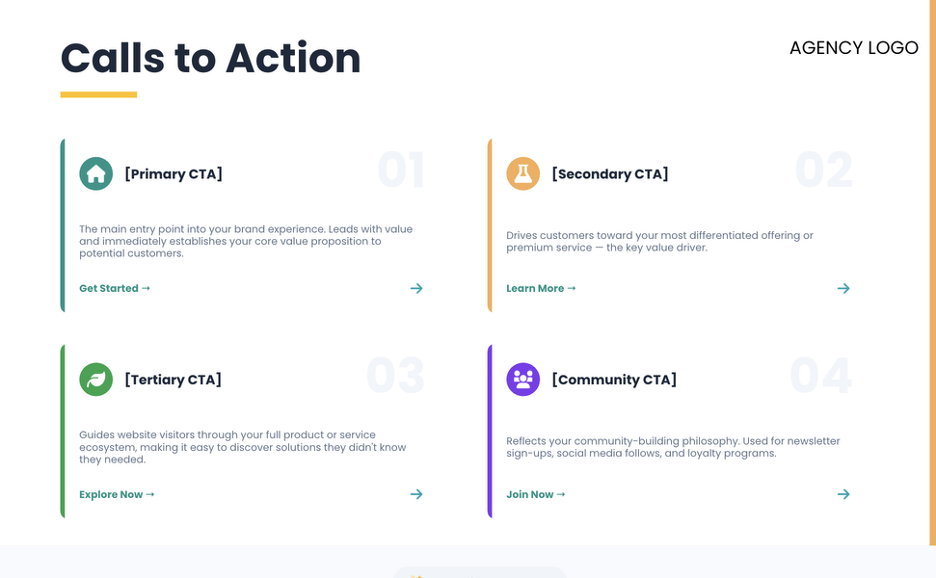
04 — Messaging Strategy The strategic center of the framework. Mission, vision, taglines, USPs, CTAs, and narrative hierarchy — structured so the brand has a clear core promise with supporting pillars that hold together across channels.
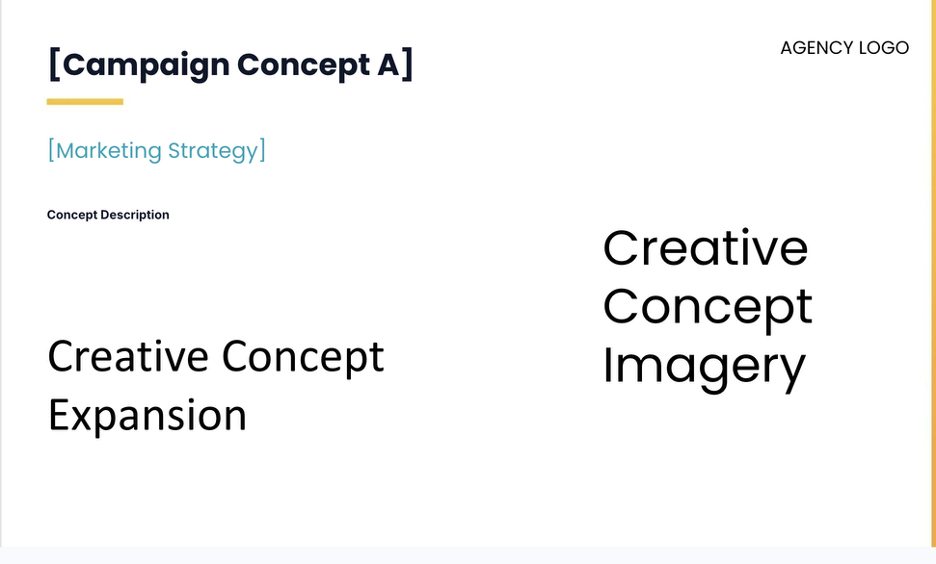
05 — Creative Ideation Campaign concepts developed directly from the strategic foundation — demonstrating how strategy comes to life in execution, and increasing client confidence in the connection between brand thinking and marketing output.
How I Use This in a Project
The framework follows a deliberate sequence from discovery through handoff:
Discovery & Input Gathering I start by collecting client inputs through an in-depth onboarding conversation, using structured questions to surface the information that will drive competitor analysis and audience definition. This shapes everything downstream.
Strategic Foundation I map the competitive landscape, identify positioning opportunities, and build out target personas based on patterns in client insights and market behavior.
Brand Definition Using those insights, I develop the brand identity system — ensuring it aligns with both business goals and audience expectations before any messaging work begins.
Messaging Development I translate the strategy into clear messaging: mission, vision, USPs, and narrative hierarchy. This becomes the foundation for all communication going forward.
Creative Application I apply the brand and messaging to campaign concepts and marketing directions — showing how the strategy connects directly to execution and making the work tangible for clients.
Handoff & Implementation The final framework is delivered as a working document used by internal teams and clients to guide ongoing marketing, content, and design decisions. It’s built to be used, not filed away.
Who Uses It
Strategists use it to structure research, define positioning, and ensure a consistent strategic approach across clients.
Designers reference brand identity, tone, and messaging to create visuals and assets that align with the strategy.
Clients and stakeholders use it as a single source of truth for their brand — helping them make consistent decisions and evaluate marketing efforts over time.
Outcomes
- Standardized the agency’s brand strategy process, replacing inconsistent, lead-dependent approaches
- Improved consistency and quality across all client deliverables
- Simplified complex brand strategy into clear, accessible outputs for non-marketing clients
- Made positioning and messaging easier for clients to understand and act on
- Increased client buy-in by showing how strategy connects directly to campaigns
- Reduced skepticism by making brand strategy more tangible and practical
- Improved client conversations by removing ambiguity and establishing a clear shared narrative
- Connected strategy to execution through integrated creative direction
- Increased team efficiency by eliminating the need to rebuild structure from scratch for each engagement
- Built a scalable system for delivering brand strategy consistently across industries
What This Demonstrates
This project reflects a specific kind of strategic work: not just applying a framework to a client, but owning the framework itself — developing it through real application, refining it based on what the work revealed, and building something that scales quality across a team.
It’s systems thinking applied to brand strategy. The ability to make complex thinking repeatable, accessible, and useful to strategists, designers, and clients alike is a different skill than producing a single strong deliverable. Both matter. This is the former.